
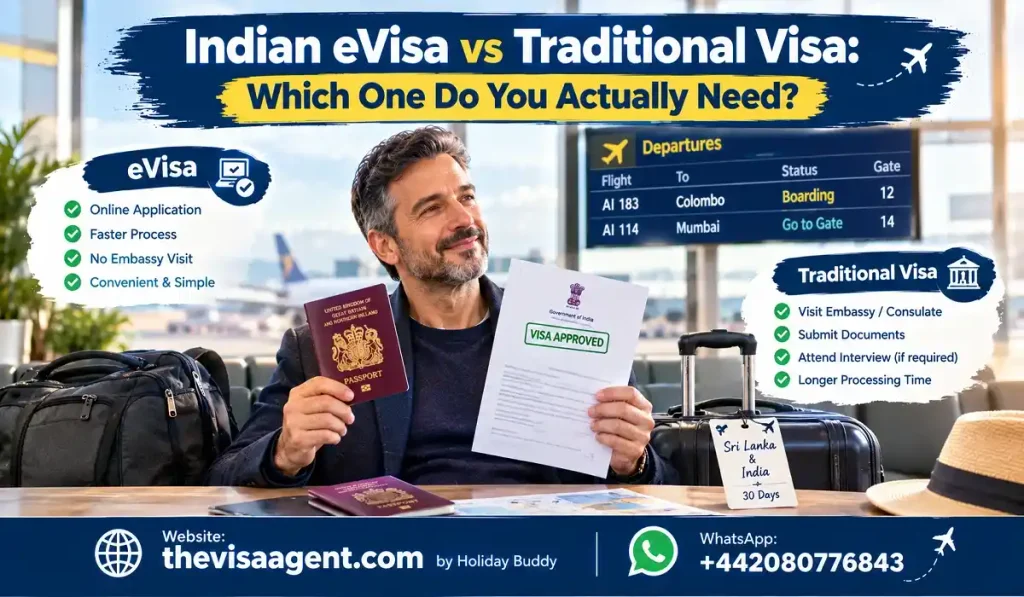
Planning a trip to India? Before you fill in any form, one question matters more than the rest: which visa route actually fits your trip?
Most travellers hear two terms — Indian eVisa vs traditional visa — and assume they’re just two ways of doing the same thing. They’re not. The eligibility rules are different. The application process is different. The documents you need are different. Even the processing times and travel conditions can vary.
Get the route wrong, and you’ll likely find out the hard way — after you’ve already paid a fee or booked a flight.
So before you apply — take ten minutes to understand both. Below, I’ll cover the main differences, who each route is for, how the process works, and what to check before you pick one.
If you’re still deciding, it also helps to understand the common reasons Indian visas get rejected — so you can avoid those mistakes from the start.
What Is an Indian eVisa?
An Indian eVisa is an electronic visa. You apply online before you travel. Fill in the form. Upload your documents and photo. Pay the fee. If approved, you get an Electronic Travel Authorisation (ETA) by email. Then you travel with your documents and show your ETA at immigration.
For most travellers, the big advantage is convenience. You do it all online — no paper process.
Here’s what you should know:
- Application: Online through the official eVisa system
- Validity: Depends on the category — e-Tourist visas can be 30 days, 1 year, or 5 years
- Stay: Depends on the visa type and your nationality
- Entry: Only designated airports or seaports
- Extension: Not possible. Not convertible either.
- Multiple entry: Available on some eVisa categories
A Quick Tip Before You Apply
If you’re still deciding on your travel plans, it’s worth understanding the common reasons Indian visas get rejected. Small details — like a blurry passport scan or a photo that doesn’t meet the specifications — can cause delays or rejection. Checking these before you submit can save you time.
You can apply directly on the government portal. But if you’d like your documents checked first, we can help.
What Is a Traditional Visa?
A traditional visa — also called a regular or paper visa — is the other route. It’s for travellers who need a visa category or travel arrangement that the eVisa system doesn’t cover. You apply through the regular visa process connected with the Indian Mission/Post and authorised application arrangements.
The requirements depend on the visa type. So don’t assume every traditional visa follows the same process.
Here’s what you should know:
- Application: Through the regular/paper visa process
- Validity: Depends on the category and what’s granted
- Stay: Varies by visa type
- Entry: Can support entry through authorised immigration check posts — airports, seaports, and land borders — subject to the visa and rules
- Extension: Depends on the specific visa category and conditions
- Multiple entry: Available for some regular visa categories
So no — a traditional visa isn’t just a longer version of an eVisa. The right option depends on your nationality, why you’re travelling, how long you plan to stay, where you’ll enter India, and which visa category actually applies to your situation.
Key Differences: Indian eVisa vs Traditional Visa
| Feature | Indian eVisa | Traditional Visa |
|---|---|---|
| How to apply | Online | Through the Indian Mission/Post or an authorised centre |
| Processing time | Varies — depends on visa type and application | Varies — depends on visa type, location, and application |
| Entry points | Only designated airports and seaports | Authorised immigration check posts — subject to visa conditions |
| Validity | Depends on the category — some tourist visas are 30 days, 1 year, or 5 years | Depends on the category and what’s granted |
| Stay duration | Depends on the category and rules | Varies by visa type |
| Extension | Not possible | Depends on the category and conditions |
| Multiple entry | Available on some categories | Available on some categories |
| Land border | Some land borders are open. | May be allowed — if the visa and rules permit |
| Passport | Stays with you | May need to be submitted |
| Who can apply | Only eligible nationalities who meet the eVisa requirements | Depends on the visa category and nationality |
Example Scenario: A Family Trip to India
A family of three from London — husband, wife, and their 5-year-old son — were flying to India on 22 July. For their son, this was a big deal. He was going to meet his grandparents for the first time.
The father first looked at the traditional visa route. What he found? It could take at least three weeks. It meant submitting their original passports. And it cost around £80 per person. With the flight getting closer, he wasn’t sure the visas would arrive in time.
So he looked at the Indian eVisa. For their situation, the 1-year eVisa had a government fee of around £30 per person. You apply online — just a passport scan and a digital photo.
The application itself wasn’t the problem. He just wanted someone to check everything before he submitted it. He didn’t want a small mistake to cause a delay.
A friend told the client to contact us for help with the application. He contacted us that evening. We reviewed the documents, guided the family through the application, and showed them how to complete the official government application.
The assistance fee for this case was £35 per passenger — £105 for the family. The government eVisa fees were about £30 per person — around £90 total. Overall cost? About £195.
The family chose the eVisa route because it suited them. No passport submission. No sending documents away.
All three applications were approved. The family could finally look forward to their trip — and their son’s first meeting with his grandparents.
This was one family’s experience. Processing times, fees, eligibility, and visa decisions can vary depending on the traveller, nationality, visa category, and government processing at the time of application.
Example Scenario: An Urgent Business Trip
A business consultant from Manchester needed to travel to India at short notice. Important meeting. Limited time. Getting the right visa became his first priority.
He first tried the regular visa route. But there was no suitable appointment before his travel date. So he looked for another option.
He contacted our team for guidance. We reviewed his documents, helped him figure out which visa route made sense, and guided him through the official process.
In situations like this, it’s not just about choosing between an Indian eVisa and a traditional visa. Your nationality. Your purpose of travel. Your entry point. The time you have left. All of it matters.
If you’re travelling to India on a tight schedule, understanding these differences before you apply can help you avoid choosing the wrong route — or making a mistake that costs you time, money, or your travel date.
Which Indian Visa Is Right for You?
Choosing between an Indian eVisa vs traditional visa comes down to a few things. Your nationality. Why you’re travelling. How long you’re staying. And how you’re entering India.
An Indian eVisa might work if you’re eligible for it, travelling for a permitted purpose like tourism, business, or medical treatment, and your trip fits the eVisa rules. It’s also convenient — you apply online, and your passport stays with you. No submitting it anywhere.
A traditional visa might be the better choice if your plans fall outside the eVisa rules. Maybe you need to enter through a land border. Maybe you need a visa category that isn’t available as an eVisa. Maybe the eVisa doesn’t cover what you need. Or maybe you’re just not eligible for it.
If your trip involves a long stopover in India — or you’re transiting through Mumbai or Delhi — you may also find our guide on Indian transit visas useful. It covers the most common mistakes, why applications get delayed, and what to check before you apply.
What About eVisa Eligibility?
Not everyone can get an Indian eVisa. Whether you qualify depends on your nationality, your passport, your personal situation, and why you’re travelling.
Some applicants with links to Pakistan face extra restrictions under the eVisa rules — including Pakistani nationals, some people of Pakistani origin, and applicants whose parents or grandparents fall under the specified criteria.
So if you’re not sure whether you qualify, don’t just pick the one that looks faster. Check the official requirements for your nationality and your situation first.
Here’s the thing: the real question isn’t “Which visa is better?” It’s “Which visa fits my trip?” Once you know why you’re travelling, what passport you hold, where you’ll enter India, and how long you’re staying — the right route usually becomes obvious.
Frequently Asked Questions
1. Can I switch from an eVisa to a traditional visa?
Generally, yes. But you’d need to submit a new application for the right category. And pay the fee again. Better to check eligibility first.
2. What if I’m not eligible for an eVisa?
Then you go through the regular visa process. Procedure and timing depend on your nationality, visa category, and where you’re applying from.
3. Can I extend my Indian eVisa?
No. Non-extendable. If you need to stay longer, check the visa and immigration rules. Don’t assume it can just be extended.
4. Which visa is cheaper — eVisa or traditional visa?
Generally, the Indian eVisa is cheaper. The government fee is usually lower. But there’s a catch — the eVisa comes with more conditions. You need to be eligible. Your trip has to fit the rules. And you can only enter through designated airports or seaports.
The traditional visa? It can cost more. But it offers more flexibility — land border entry, longer stays, and visa extensions in some cases.
So it’s not just about the price. It’s about what you need.
And if you use a consultancy? The service fee is separate from the government fee..
5. How long does an Indian eVisa or traditional visa take?
Varies. Depends on visa category, nationality, application details, and government processing. Don’t rely on a fixed number of days unless official guidance confirms it for your visa type.
6. Can I enter India through any airport with an eVisa?
No. Designated airports or seaports only. Check the official list before you book or travel.
7. Do I need a traditional visa to enter India through a land border?
Yes. EVisas don’t permit land border entry. If you’re entering by land, check if you need a regular visa — and if your border crossing is authorised.
8. What if I have a Pakistani or Bangladeshi connection?
Some applicants with Pakistani-related connections face specific eVisa restrictions. It depends on nationality, origin, and family circumstances. Don’t assume you’re eligible based on your passport alone.
If this applies to you, check the official guidance before you apply.
About the Author
I’m Preet, and I’ve spent over 12 years helping travellers figure out which Indian visa route actually fits their trip. In that time, I’ve seen the same mistakes come up again and again — wrong visa category, documents that don’t match, applications submitted too late.
So here’s what we do at thevisaagent.com by Holiday Buddy: we look at your journey, not just your form. We check the requirements. We help you prepare the application. We make sure it’s submitted the right way.
We don’t guarantee approvals. We don’t promise government timelines. We just help you get the application right.
For more guides on Indian visa applications — including Indian Visa Delay and Visa Rejected Due to Photo or Passport — explore our complete India visa guide.
Disclaimer: We are an independent visa consultancy and are not affiliated with, authorised by, or endorsed by the Government of India or the Ministry of External Affairs. Visa applications are processed and decided by the relevant Indian authorities. We do not guarantee visa approval or a specific processing time. For the latest visa requirements and to apply through the official channel, please use the official Indian eVisa website.